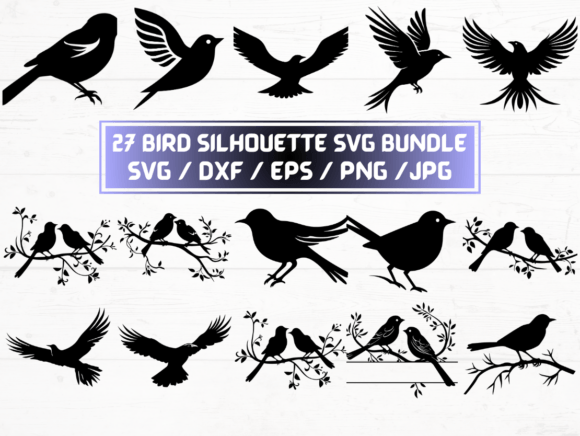
Bird on a Branch SVG: A Strategic Design Asset for Purpose-Driven Creators
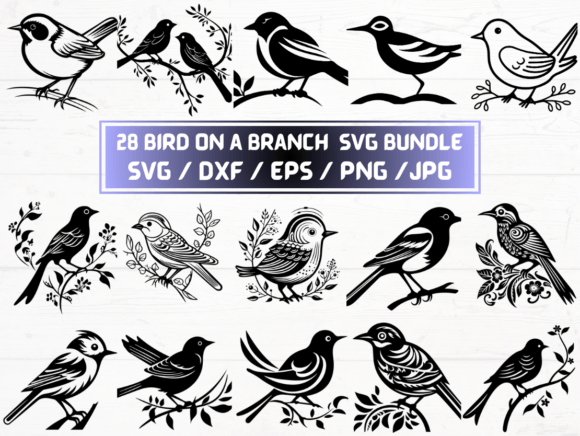
When you choose a Bird on a Branch SVG, you’re not selecting decorative clipart—you’re acquiring a versatile, production-ready visual element with clear functional advantages. This isn’t about filling space or adding whimsy on impulse. It’s about aligning visual assets with intention: brand consistency, scalable output, cross-platform compatibility, and time-efficient execution. The 28-file ZIP package—containing SVG, PNG (300 dpi, transparent background), DXF, JPG, and EPS formats—reflects a deliberate design infrastructure. That breadth signals readiness—not just for crafters cutting vinyl or plotting embroidery, but for professionals building digital products, educators designing learning materials, or small business owners refining customer touchpoints.
Why Format Diversity Matters More Than You Think
Each file type serves a distinct operational need—and overlooking that distinction risks wasted effort or compromised output. SVG files scale infinitely without quality loss, making them ideal for responsive web interfaces, interactive dashboards, or embedded icons in SaaS platforms. PNGs at 300 dpi with transparency support high-fidelity print layouts, social media banners, or layered presentations where precise masking matters. DXF files bridge the gap between digital design and physical fabrication—essential for laser engravers, CNC routers, or sign shops producing branded merchandise. EPS remains relevant for legacy print workflows requiring vector fidelity in Adobe Illustrator or InDesign. JPGs offer lightweight embedding for email templates or CMS-based blogs where file size affects load speed.
Having all five formats in one ZIP means you avoid format conversion errors, maintain original line integrity, and reduce dependency on third-party tools or freelancers for basic asset prep. That’s not convenience—it’s operational resilience. For a freelance designer delivering to multiple clients across industries, or an educator preparing classroom resources for both screen-based instruction and printed handouts, this eliminates guesswork and version control friction.
Strategic Use Cases Beyond Decoration
A Bird on a Branch SVG gains strategic value when anchored to specific outcomes—not aesthetics alone. Consider these grounded applications:
- Brand Identity Systems: Used as a subtle watermark, favicon, or recurring motif in pitch decks and proposal documents—reinforcing visual continuity without overwhelming messaging.
- Educational Materials: Integrated into science lesson plans about avian biology or ecology, where the clean vector outline supports annotation, labeling, or student-led illustration exercises.
- Customer Experience Touchpoints: Embedded in welcome emails, packaging inserts, or loyalty program graphics to evoke calm, observation, or natural balance—aligning tone with service values like patience, clarity, or thoughtful support.
- Product Packaging & Merchandise: Applied to eco-friendly product labels or reusable tote bags, where the branch-and-bird motif communicates sustainability without literalism—especially effective when paired with minimal typography and earth-toned palettes.
Notice how each use case ties the visual to function: recognition, comprehension, emotional resonance, or brand alignment. That’s the difference between using a Bird on a Branch SVG as filler versus using it as a tactical component of communication strategy.
What to Evaluate Before Integration
Before dropping the file into your next project, ask three questions:
- Does this serve a defined objective—or is it satisfying an aesthetic preference? If the answer leans toward “it looks nice,” pause. Revisit your goal: Is it improving readability? Supporting narrative flow? Differentiating a product variant? Without that anchor, even a well-executed Bird on a Branch SVG can dilute focus rather than enhance it.
- Which format matches the delivery context—and have you verified its behavior? Don’t assume an SVG will render identically across all browsers or email clients. Test it in your target environment. Likewise, confirm DXF layers are correctly grouped if feeding into a laser cutter—misaligned paths cause material waste and rework.
- Is this part of a repeatable system—or a one-off exception? If you’re using it once in a blog post header, fine. But if you plan to deploy variations across ten client websites, consider creating a style guide entry: recommended sizing ratios, color treatment rules, spacing guidelines, and acceptable contexts. That transforms a single asset into a scalable design principle.
Risks of Context-Free Usage
Using a Bird on a Branch SVG without strategic framing carries quiet but measurable costs. First, inconsistency: applying it in bold colors on one landing page and muted grayscale on another weakens visual memory and undermines brand recall. Second, misalignment: placing it beside urgent CTAs (“Limited Time Offer!”) creates cognitive dissonance—the imagery suggests stillness and reflection, not scarcity or urgency. Third, accessibility oversights: relying solely on the bird icon to convey meaning without supporting text fails users who rely on screen readers or have low visual literacy.
These aren’t hypothetical pitfalls. They emerge when assets are treated as interchangeable decoration instead of intentional communication tools. The ZIP package gives you flexibility—but flexibility without direction leads to fragmentation, not fluency.
How to Build Intentionality Into Your Workflow
Start small. Pick one upcoming project—a newsletter template, a workshop slide deck, or a product label mockup—and treat the Bird on a Branch SVG as a constraint, not a feature. Ask: What role must it play? Then choose the format accordingly. If it’s for web, use SVG with descriptive aria-label attributes. If it’s for print, verify the PNG’s resolution and embed it in CMYK-safe layouts. Document your choice and rationale—even briefly—in your project notes. Over time, those decisions compound into informed habits.
Also, audit existing usage. Search your design library or CMS for past deployments. Are they clustered around similar goals? Do they follow consistent sizing or positioning patterns? If not, identify the outlier cases and assess whether they succeeded—or simply went unnoticed. That retrospective clarity informs future judgment far more reliably than theoretical best practices.
Long-Term Value Lies in Repurposing, Not Stockpiling
Many creators download dozens of SVG packs “just in case.” But value accrues not from volume, but from reuse with refinement. A Bird on a Branch SVG used across three distinct contexts—with thoughtful adjustments to color, scale, and surrounding whitespace—builds recognition and reinforces thematic cohesion. That same file, deployed identically across ten unrelated projects, becomes noise.
Think of it as a foundational module: adaptable, interoperable, and traceable. When you update your brand palette, you adjust the SVG fill once—and propagate that change across all outputs. When you shift messaging from “innovation” to “stewardship,” you retain the motif but pair it with different typography and supporting imagery. That kind of agility doesn’t happen by accident. It happens when you treat every digital asset—not just the Bird on a Branch SVG—as a living component of your communication ecosystem.
The ZIP folder delivers technical readiness. Your discipline delivers strategic impact. Choose the latter first—and let the files follow.