Fish SVG Files: Creative Freedom for Crafters, Educators, and Small Business Owners
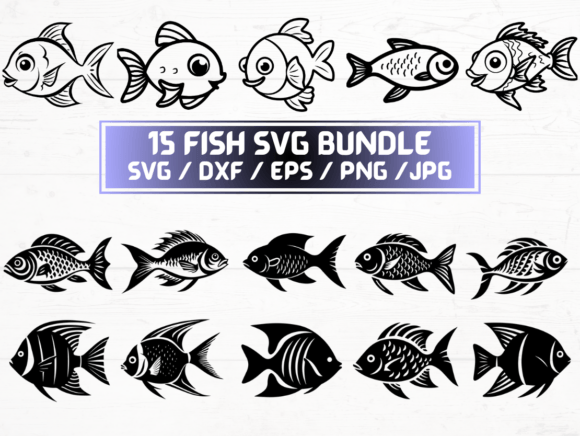
If you've ever spent hours tracing a fish outline for a classroom poster—or paused mid-project because your design software couldn’t handle layered cut files—you already know the quiet frustration of working with generic or low-quality graphics. Fish SVG Files solve that—not as a flashy tool, but as a quietly reliable resource built for real work. This isn’t just another clipart pack. It’s a thoughtfully assembled set of 15 distinct fish designs, each delivered in five industry-standard formats: SVG, DXF, EPS, PNG (300 dpi with transparent background), and JPG. All packed into one ZIP folder. No waiting. No shipping. Just instant access to clean, scalable, production-ready assets.
Where These Fish SVG Files Actually Show Up in Real Life
You won’t find these files gathering dust in a digital drawer. They’re showing up on nursery walls, laser-cut coasters, elementary science displays, and even small-batch apparel lines—because versatility is baked into every file.
- Crafters using Cricut or Silhouette machines reach for the SVG and DXF versions first. Why? Because they preserve precise paths, compound shapes, and layer integrity—so when you’re cutting vinyl for an aquarium-themed baby shower banner, the dorsal fin doesn’t vanish or warp at the edges. One user shared how she used the angelfish design to create reusable iron-on transfers for kids’ swim lesson T-shirts—no pixelation, no alignment headaches.
- Teachers and homeschoolers lean on the high-res PNGs. That transparent background means dropping a clownfish straight onto a coral reef worksheet—or layering it over a water cycle diagram—takes seconds, not minutes. One 4th-grade teacher told us she printed the PNGs on cardstock, laminated them, and turned them into tactile sorting cards for marine biology units. The crisp detail held up after months of student handling.
- Small business owners launching eco-branded merchandise use the EPS files for vector-based print prep. Whether it’s screen-printing a subtle wave-and-fish motif on organic cotton tote bags or engraving a minimalist swordfish on bamboo coasters, EPS ensures sharp output at any size—no reworking needed when scaling from business card to storefront banner.
Who Benefits—and How Their Needs Shape the Use
The beauty of this collection lies in how differently people engage with it—not based on technical skill alone, but on context, constraints, and creative goals.
A busy preschool director might download the ZIP, open the PNGs in Canva, and have a dozen underwater-themed name tags designed before her morning coffee cools. She doesn’t need layers or nodes—she needs clarity, speed, and something that prints cleanly on a standard office printer. For her, the transparent-background PNGs aren’t a feature—they’re the difference between “I’ll do it later” and “It’s done.”
Meanwhile, a freelance graphic designer building a branding package for a new seafood restaurant will likely open the EPS or SVG files in Adobe Illustrator. There, she’ll recolor the pufferfish to match the client’s ocean-blue palette, adjust stroke weights for menu icons, and export optimized web versions—all without losing fidelity. Here, the vector scalability and multi-format flexibility save hours of redrawing or licensing third-party assets.
And for makers running Etsy shops? The DXF files are often the unsung heroes. They import cleanly into Glowforge, Boss Laser, or even free tools like Inkscape—meaning someone selling wooden fish-shaped keychains can go from download to test cut in under ten minutes. No conversion glitches. No missing curves.
What to Keep in Mind Before You Jump In
While Fish SVG Files are purpose-built for ease, a few practical considerations help you get the most out of them—especially if you're new to digital design or cutting machines.
- Software compatibility matters more than you think. SVG works natively in Cricut Design Space, Silhouette Studio (with Designer Edition), and most modern browsers—but older versions of CorelDRAW or basic versions of Silhouette may require converting to DXF first. If you’re unsure, start with the DXF files; they’re widely supported across cutting platforms.
- Transparency ≠ automatic background removal. The PNGs come with transparent backgrounds, yes—but if you open them in Microsoft Word or PowerPoint, that transparency sometimes renders as white. For best results, use them in Canva, Google Slides (with proper upload), or design apps that honor alpha channels.
- These aren’t animated or interactive files. They’re static, single-layer vector and raster assets—ideal for printing, cutting, and embedding, but not for web animations or app interfaces. If you need motion or interactivity, you’d layer these into other tools (like After Effects or Figma), not expect it out of the box.
- No commercial license restrictions—but check your platform. These files are cleared for both personal and commercial use (including resale on physical products like mugs or shirts). However, some POD platforms—like Redbubble or Teespring—require you to confirm originality or add significant customization. Using one of these fish as-is on a plain white shirt *may* trigger a review; pairing it with custom typography or a hand-drawn background usually satisfies their guidelines.
Why Format Variety Isn’t Overkill—It’s Necessity
At first glance, 75 total files (15 designs × 5 formats) might seem excessive. But in practice, that variety eliminates guesswork and workflow bottlenecks. Think about it:
- Your friend swears by Inkscape (free, open-source) and uses SVG daily—but her sister runs a sign shop where the CNC router only accepts DXF. Same design. Two different entry points.
- You’re prepping a school presentation and need to embed a fish icon into a PDF handout. EPS gives you crisp vector rendering inside Acrobat. Trying to scale a JPG there would blur instantly.
- You’re testing a new sublimation printer and want to preview how fine details hold up. The 300 dpi PNG lets you soft-proof color and edge quality before committing to a $20 blank mug.
In short, the range of formats means you’re never forcing a square peg into a round hole. You pick the file that fits your tool, your timeline, and your end goal—not the other way around.
A Quiet Kind of Practicality
There’s no grand claim here about revolutionizing marine illustration or replacing professional designers. What Fish SVG Files deliver is something quieter but just as valuable: consistency, reliability, and time returned. Time you spend refining a lesson plan instead of troubleshooting a corrupted vector. Time you invest in stitching a custom quilt instead of redrawing fins for the fifth time. Time you redirect toward customers, students, or family—because the foundation is already solid.
Whether you’re labeling a tide pool display at a nature center, prototyping a logo for a coastal yoga studio, or helping your kid build a diorama for science fair, these files meet you where you are—with clarity, flexibility, and zero fluff.