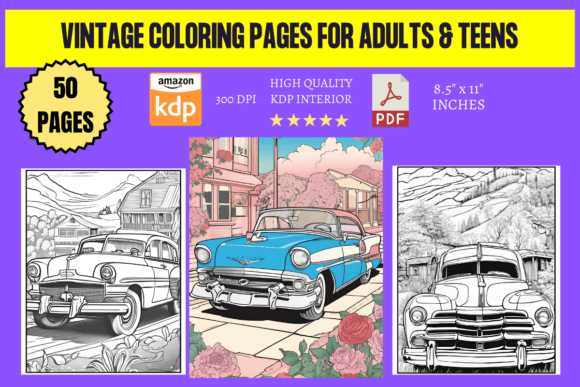
Vintage Cars Coloring Pages for Adults
Coloring isn’t just for kids anymore—and it never really was. What began as a nostalgic pastime has evolved into a widely adopted tool for focus, creative expression, and mindful decompression. Today’s professionals, educators, and hobbyists are turning to structured, high-quality coloring resources not as escapism, but as intentional pauses in demanding routines. Vintage Cars Coloring Pages for Adults sit at the intersection of this shift: they combine aesthetic richness, historical charm, and practical utility in a format that works across devices, workflows, and age groups.
More Than Nostalgia—A Designed Creative Pause
These 50 vintage car illustrations aren’t random clipart repurposed for coloring. Each page is a deliberate design—clean linework, balanced negative space, and thoughtful detail placement that invites engagement without overwhelming. Think of a 1937 Cord 812 Phaeton with its distinctive front grille, or a 1955 Chevrolet Bel Air in side-profile, its curves echoing mid-century optimism. These aren’t just outlines; they’re visual anchors that spark recognition, curiosity, and quiet attention.
That matters because adult coloring works best when it supports *intentional rest*—not passive scrolling. A well-proportioned line drawing on an 8.5″ x 11″ canvas gives the eye enough structure to settle in, while leaving room for personal interpretation. You’re not replicating a photo—you’re responding to shape, rhythm, and memory. That subtle cognitive shift—from problem-solving to pattern-recognizing—is why therapists, UX designers, and teachers alike have quietly integrated coloring into their toolkits.
Why Vintage Cars? Timing, Texture, and Timelessness
Vintage automobiles occupy a rare cultural sweet spot: universally recognizable, yet richly varied; technically precise, yet emotionally evocative. Unlike abstract mandalas or floral motifs—which serve specific relaxation goals—vintage cars carry narrative weight. A 1928 Duesenberg Model J whispers craftsmanship. A 1963 Jaguar E-Type suggests speed and elegance. A 1948 Tucker 48 hints at innovation and ambition. That layered resonance makes them especially effective for adults seeking both calm *and* stimulation.
This aligns with broader shifts in how people consume creative content. Streaming fatigue, notification overload, and algorithm-driven feeds have made analog-adjacent experiences more valuable—not because they’re “old,” but because they’re *unmediated*. Printing a single vintage car page, grabbing a set of colored pencils, and spending 20 focused minutes filling in chrome trim or wheel spokes offers something digital rarely delivers: full sensory presence without performance pressure.
Practical Flexibility Built In
The technical specs reflect real-world use: 50 PNG files, print-ready at 8.5″ x 11″, 300 DPI resolution, and Amazon KDP upload compatibility. That’s not just convenience—it’s workflow awareness. A freelance illustrator might extract one image to layer over a client mockup. An educator could print five pages for a history unit on postwar American industry. A small business owner selling curated gift bundles can include a themed coloring sheet alongside vintage-style stationery or coffee mugs.
And yes—these pages work beautifully for children too, but not as an afterthought. The clean lines reduce frustration for developing motor skills, while the subject matter invites intergenerational conversation: “What do you think this car was used for?” “Why do you think the headlights look like that?” That dual usability isn’t accidental—it reflects how modern households and classrooms increasingly value resources that scale across ages without diluting depth.
Real-World Applications Across Roles
- For creators and marketers: Use individual pages as social media assets—coloring time-lapse reels, before/after shares, or behind-the-scenes process posts. Vintage car imagery already performs well on Pinterest and Instagram; adding an interactive, printable layer increases dwell time and saves.
- For educators and homeschoolers: Pair a 1950s Ford Thunderbird page with lessons on industrial design, material science (steel vs. fiberglass), or even economic history (the rise of suburban car culture). Coloring becomes a tactile entry point—not a distraction from learning.
- For freelancers and remote workers: Print a page and keep it beside your desk. When switching between Zoom calls and writing sprints, five minutes of focused coloring resets visual fatigue better than another scroll through email.
- For small business owners: Bundle select pages as low-cost digital add-ons to physical products—e.g., include a printable “1932 Ford Hot Rod” sheet with a custom air freshener shaped like a vintage radiator cap.
Not Just a Trend—A Sustainable Creative Habit
Unlike apps that require updates, logins, or subscriptions, these coloring pages offer frictionless access. No download limits. No expiration. No third-party tracking. You own the files. You decide how—and when—to use them. That autonomy is increasingly rare, and increasingly valued. It also means longevity: a printed page doesn’t crash, buffer, or get deprecated by a platform update.
This durability matters for professionals building long-term creative practices. A designer maintaining a visual journal might scan and annotate a completed 1940 Packard page alongside notes on color theory. A writer drafting a period novel could use a 1929 Bentley Speed Six illustration as a mood anchor during research sprints. The pages don’t replace those tasks—they support them, quietly and consistently.
Design Integrity Meets Everyday Utility
High-resolution JPG and PNG formats ensure fidelity whether you’re printing on standard copy paper or premium matte stock. The 300 DPI standard meets commercial print expectations—so if you’re preparing a physical coloring book for local craft fairs or school fundraisers, these files integrate cleanly. And because they’re KDP-ready, launching a paperback version requires minimal formatting overhead—just compile, preview, and publish.
That technical readiness reflects a deeper principle: good creative tools shouldn’t demand expertise to use. You don’t need to know vector paths or CMYK profiles to benefit from these pages. You just need curiosity, a few colors, and 10–15 uninterrupted minutes. That accessibility lowers the barrier to entry without sacrificing quality—a balance many digital-first tools still struggle to achieve.
Getting Started—No Setup Required
- Download the full set—50 unique vintage car designs, each sized for standard US letter paper.
- Choose one page based on mood or interest: sleek European roadster, bold American muscle, or elegant pre-war sedan.
- Print on your preferred paper (even recycled works well—the line art holds up).
- Use pencils, gel pens, watercolors, or markers—no “right” medium. The goal is engagement, not perfection.
- Repeat as needed. There’s no schedule, no grading, no outcome required—just presence.
What makes Vintage Cars Coloring Pages for Adults resonate today isn’t novelty—it’s reliability. In a landscape where attention is fragmented and tools multiply faster than we can master them, these pages offer something steady: clarity of purpose, consistency of format, and quiet celebration of enduring design. They don’t ask you to optimize, upgrade, or pivot. They invite you to pause, observe, and fill in the lines—at your own pace, in your own way.