Golf Cart SVG Design Files: A Versatile Digital Toolkit for Creative and Commercial Projects
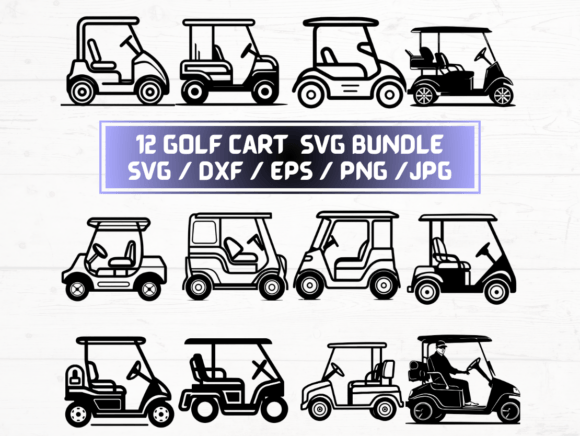
Whether you're customizing fleet signage for a resort, designing apparel for a golf tournament, or prototyping vehicle decals in a makerspace, Golf Cart SVG files serve as foundational digital assets—scalable, editable, and production-ready. Unlike raster images, vector-based formats like SVG, DXF, and EPS retain crisp clarity at any size, making them indispensable across manufacturing, digital fabrication, and graphic design workflows. This article explores how a curated set of 12 Golf Cart SVG designs—delivered alongside matching PNG, JPG, DXF, and EPS files—functions not just as decorative elements, but as interoperable components within real-world creative pipelines.
Why Vector Precision Matters Across Industries
At its core, a Golf Cart SVG is more than an illustration—it’s a mathematically defined outline. Each curve, corner, and contour is expressed using coordinates and path commands, enabling infinite scalability without pixelation. This characteristic directly impacts usability:
- Laser cutting and CNC routing: DXF files—compatible with most industrial machines—translate vector paths into precise toolpaths. A single Golf Cart SVG design can be converted to DXF and cut from acrylic for dashboard badges or aluminum for maintenance bay signage.
- Screen printing and vinyl application: EPS and high-resolution PNGs (300 dpi with transparent backgrounds) allow designers to isolate cart silhouettes cleanly against colored substrates—critical when applying graphics to golf cart seat covers, trailer wraps, or event banners.
- Digital publishing and web integration: SVG files embed natively in HTML, supporting responsive resizing, CSS styling, and accessibility features like ARIA labels—ideal for interactive course maps or educational modules about sustainable transportation on campuses.
This cross-format compatibility isn’t incidental. The inclusion of 12 distinct Golf Cart SVG variants—each paired with 12 corresponding files in PNG, JPG, DXF, and EPS—ensures users aren’t forced to convert or trace assets manually. That saves time, reduces error risk, and preserves fidelity across platforms—from Adobe Illustrator to Cricut Design Space to AutoCAD LT.
Real-World Applications Beyond Decoration
While many assume SVG files are used only for logos or social media graphics, the practical scope of Golf Cart SVG assets extends meaningfully into operational, instructional, and experiential domains:
Educational Tools and Curriculum Development
Engineering instructors use scaled Golf Cart SVG outlines to teach principles of center of gravity, aerodynamic drag, or battery compartment layout. Because vectors maintain proportional accuracy, students can overlay measurements, annotate subsystems, or simulate modifications in vector editors before building physical prototypes. Similarly, vocational programs preparing learners for EV technician certification integrate these files into diagnostic flowcharts—overlaying fault codes or wiring diagrams onto accurate cart schematics.
Municipal and Resort Fleet Management
Cities operating shared mobility carts in parks or historic districts often require standardized visual identifiers for maintenance tracking. A Golf Cart SVG file can be adapted into QR-coded asset tags—embedded in a DXF for metal stamping or printed via UV-curable inkjet on durable vinyl. The same base design scales seamlessly from a 2-inch label on a brake caliper to a 48-inch wall chart in a service garage.
Hobbyist Innovation and Custom Fabrication
DIY enthusiasts frequently modify carts for terrain adaptability, solar charging, or cargo capacity. With editable SVG and DXF files, they import outlines into Fusion 360 or Inkscape to draft custom brackets, mounting plates, or LED light housings. One documented case involved a Florida community group using a Golf Cart SVG as the foundation for a 3D-printed canopy mount—extruding the roofline profile into a parametric model that accommodated varying sun angles and wind loads.
Understanding the File Ecosystem: When to Use Which Format
Although all 60 files (12 per format) depict identical cart designs, their underlying structure dictates optimal usage:
- SVG: Best for web embedding, animation, and accessibility. Supports CSS classes and JavaScript interactivity—e.g., highlighting different cart models on a resort website map.
- DXF: Industry standard for CAD/CAM workflows. Required for CNC mills, plasma cutters, and waterjet systems. Does not support color or gradients—only geometry and layers.
- EPS: Legacy print format with embedded preview; still preferred by some commercial printers for large-format output where font embedding and spot color handling matter.
- PNG (300 dpi, transparent background): Ideal for mockups, presentations, and layered composites—especially when blending cart graphics with photography of real environments (e.g., showing a branded cart on a greenside path).
- JPG: Useful for quick reference, email previews, or CMS uploads where transparency isn’t needed and file size is constrained.
Note: None of these are fonts, templates, or editable text documents. They’re ready-to-deploy vector and raster representations—meaning no subscription, no licensing fees beyond the initial purchase, and no dependency on proprietary software to open or repurpose them.
Workflow Integration: From Download to Deployment
After the instant ZIP download, users typically follow one of three primary pathways—each reflecting different technical comfort levels and end goals:
- The Designer Path: Open the SVG in Figma or Illustrator → adjust stroke weight or fill color → export new variants for client approval → place into InDesign layout for a tournament program booklet.
- The Maker Path: Import the DXF into LightBurn or Carbide Create → assign power/speed settings for 1/8" birch plywood → run on a diode laser cutter → assemble engraved control panel overlays.
- The Educator Path: Insert the PNG into a Google Slides deck → annotate braking zones with arrows → save as PDF for student handouts → embed the SVG into a H5P interactive diagram for self-paced learning.
What unifies these paths is consistency: the same underlying design language appears across outputs, reinforcing brand recognition, instructional continuity, or fabrication repeatability. That cohesion wouldn’t be possible with low-res screenshots or traced JPEGs.
Considerations for Ethical and Effective Use
While Golf Cart SVG files offer flexibility, responsible deployment involves awareness of context and constraints:
- Scale integrity: Resizing a cart silhouette to fit a tiny embroidery hoop (e.g., 1.5 inches wide) may require simplifying fine details like wheel spokes or mirror mounts—something easily done in vector editors but impossible to recover from a flattened JPG.
- Color fidelity: RGB values in PNGs may shift slightly when converted to CMYK for offset printing. Always soft-proof using ICC profiles specific to your printer and substrate.
- Intellectual property boundaries: These files are licensed for unlimited personal and commercial use—including resale of physical products featuring the designs—but do not grant trademark rights to “golf cart” terminology or likeness of specific OEM models (e.g., Club Car Precedent or Yamaha Drive2). Users remain responsible for compliance with local signage ordinances or event branding guidelines.
Importantly, because this is a digital-only product—no physical item ships—the environmental footprint is near-zero. There’s no packaging waste, no shipping emissions, and no inventory obsolescence. Updates or corrections (e.g., adding left-hand-drive variants) can be delivered instantly, supporting long-term usability without resource expenditure.
Emerging Trends Amplifying SVG Utility
Three converging developments are increasing the strategic value of well-structured Golf Cart SVG libraries:
First, generative design tools now accept vector inputs as constraints—allowing AI-assisted optimization of accessory mounts or airflow channels based on the cart’s exact body geometry. Second, AR-enabled maintenance apps use SVG outlines as anchor points for overlaying repair instructions onto live camera feeds—imagine pointing a tablet at a cart’s rear axle and seeing animated torque sequences aligned precisely to the SVG-defined component boundaries. Third, modular documentation systems in facilities management increasingly rely on SVG-based schematics that link to IoT sensor data—clicking a battery icon in the Golf Cart SVG triggers live voltage readings from onboard telemetry.
These applications don’t require advanced coding skills—they begin with clean, well-organized vector assets. That’s why having 12 stylistically varied yet technically consistent Golf Cart SVG options matters: diversity in perspective (front, side, angled, simplified, detailed), orientation (left/right facing), and complexity (with/without accessories) supports adaptation across evolving tools and standards.
Conclusion: Scalability as a Functional Asset
A Golf Cart SVG is rarely evaluated in isolation. Its worth emerges through reuse—across departments, devices, materials, and timelines. Whether it becomes part of a county’s green transportation report, powers a student’s capstone project, or accelerates turnaround for a custom cart wrap business, its value lies in fidelity, flexibility, and frictionless integration. The deliberate inclusion of five complementary file types ensures that no user hits a format wall—whether they’re preparing files for a $200 vinyl cutter or a $200,000 robotic arm. In an era where speed, precision, and sustainability intersect, vector design files like these aren’t just convenient. They’re infrastructure.