Guitar SVG Files: A Practical Guide for Crafters, Designers, and Makers
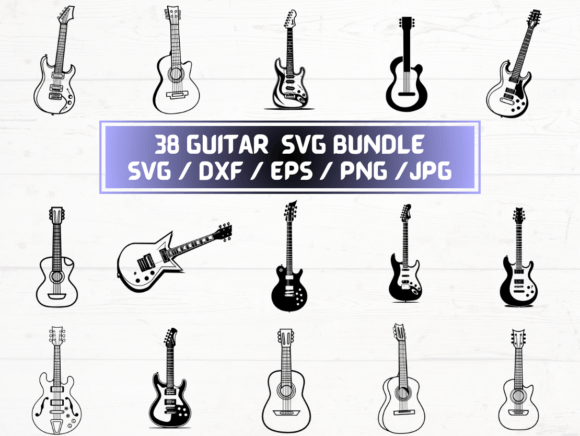
When you search for guitar-themed design assets, “Guitar SVG” refers to scalable vector graphics specifically created for digital cutting machines, graphic design software, and print-on-demand workflows. Unlike raster images or generic clipart, Guitar SVG files maintain crisp edges at any size and support layer-based editing—making them ideal for precision tasks like vinyl cutting, laser engraving, or custom apparel design. The listing described—5 file types (SVG, PNG, DXF, JPG, EPS), 38 unique guitar designs, delivered instantly as a ZIP archive—represents a common format used by independent designers and small studios catering to makers who value flexibility and compatibility.
What Sets Guitar SVG Apart from Other Guitar Graphics?
At its core, a Guitar SVG is not just an image—it’s a structured, editable vector path. Each string, fretboard curve, and body contour is defined mathematically, allowing users to resize without pixelation, recolor individual elements, or isolate components for multi-layer projects. This differs fundamentally from JPG or PNG files, which are fixed-resolution raster images best suited for web display or simple printing. While the included PNGs (300 dpi, transparent background) work well for mockups or digital overlays, they can’t be cut on a Cricut or Silhouette without conversion—and even then, with reduced fidelity.
DXF files, also included in the bundle, serve a similar purpose to SVG but are more commonly used in CAD environments and some older or industrial cutting systems. They lack color or fill data but retain precise geometry—making them reliable for CNC routing or architectural modeling where line accuracy matters more than visual styling. EPS files offer broader compatibility with professional print workflows (e.g., Adobe Illustrator pre-2020), though they’re less intuitive for hobbyist cutters than SVG.
How Guitar SVG Fits Into Real-World Workflows
Consider two common scenarios:
- A small-batch t-shirt seller uses Guitar SVG files to create layered iron-on transfers. They adjust stroke width for clean heat-press results, group fret markers separately for alignment, and export PNG previews for client approvals—all within one editable file.
- A woodworking hobbyist imports the same Guitar SVG into LightBurn or RDWorks to engrave a detailed acoustic silhouette onto a guitar stand. The vector paths translate directly to laser motion commands, preserving subtle curves that would blur or distort in a low-res JPG.
In both cases, the Guitar SVG acts as the source of truth—the master asset from which other formats derive. The bundled PNGs, JPGs, and EPS files extend usability but don’t replace the functional advantages of the native SVG structure.
Tradeoffs to Consider Before Downloading
While Guitar SVG bundles like this one offer broad format coverage, they come with practical limitations worth weighing:
- No customization included. These are ready-to-use files—not bespoke illustrations. If you need left-handed orientation, alternate tunings marked on fretboards, or specific brand silhouettes (e.g., Fender Stratocaster vs. Gibson Les Paul), manual editing or commissioning may be necessary.
- Design consistency varies. With 38 distinct guitar graphics, styles range from minimalist outlines to stylized silhouettes with shading or decorative flourishes. Some may suit modern branding; others lean vintage or cartoonish. Review thumbnails carefully—especially if you plan cohesive series across merchandise or signage.
- Software compatibility isn’t universal. Though SVG is widely supported, certain cutting machines (like older Cricut models) require simplified paths or flattened layers. You may need to ungroup, combine, or simplify objects in Inkscape or Illustrator before cutting—particularly for intricate fretboard details or overlapping strings.
When Guitar SVG Is the Right Choice
This type of digital product makes sense when you prioritize speed, repeatability, and cross-platform utility over one-off artistic uniqueness. It’s especially valuable if you:
- Regularly produce guitar-related items—stickers, decals, wall art, or engraved gifts—and want to avoid redrawing the same shapes repeatedly;
- Work across multiple tools (e.g., designing in Canva, cutting on a Silhouette, prepping files for a local print shop) and need formats that behave predictably in each environment;
- Prefer self-service solutions over hiring a designer for every variation (e.g., changing colors, scaling for different substrates, or exporting for web vs. physical use).
For educators building music-themed classroom materials, small business owners launching a guitar lesson studio, or Etsy sellers expanding their instrument niche, having a library of consistent, production-ready Guitar SVG files reduces friction between idea and output.
When You Might Need Something Else
Not every project benefits from a pre-made Guitar SVG bundle. Consider alternatives if:
- You require photorealistic detail—such as wood grain texture, reflection highlights, or realistic string tension—that vector paths alone can’t convey. In those cases, high-res JPGs or layered PSD files may better serve your needs.
- Your workflow relies heavily on parametric design (e.g., generating custom guitar shapes based on scale length or body depth). Here, CAD-native files or script-driven tools (like OpenSCAD or Fusion 360 templates) offer more adaptability than static SVGs.
- You’re developing a branded visual identity and need exclusive rights or trademark-safe derivatives. Most marketplace Guitar SVG files carry standard commercial licenses—sufficient for most small-scale uses, but insufficient for large-scale merchandising or logo integration without verifying license terms.
Comparing Guitar SVG With Broader Design Resource Options
Guitar SVG sits between two broader categories: generic icon sets and fully custom illustration services. Icon libraries (e.g., Noun Project or Flaticon) often include basic guitar symbols—but usually as single-color, simplified glyphs lacking the anatomical accuracy or layer separation found in dedicated Guitar SVG collections. Meanwhile, commissioning a custom illustrator gives full control over style, proportions, and usage rights—but at higher cost and longer turnaround.
This bundle occupies a pragmatic middle ground: professionally drawn, technically optimized, and immediately deployable. Its strength lies not in novelty but in reliability—38 variations mean you’re unlikely to hit a dead end mid-project because one angle or perspective is missing.
Making an Informed Decision
Before downloading any Guitar SVG package, ask yourself three questions:
- What’s my primary output method? If you’re cutting vinyl or plotting with a pen plotter, SVG and DXF are essential. If you’re only creating social media banners or website headers, PNGs may suffice—and paying for extra formats adds little value.
- Do I need editability—or just visual variety? If you’ll change colors, crop sections, or combine elements with other graphics, editable vectors matter. If you’re selecting final images for static use, preview quality and stylistic match matter more than file format.
- How scalable is my current setup? A beginner using Cricut Design Space may find 38 options overwhelming without tutorials or layer notes. An experienced user in Inkscape or Affinity Designer will leverage the full set more efficiently—and may even repurpose DXF files for non-cutting applications like 3D modeling references.
There’s no universal “best” Guitar SVG bundle—only the one aligned with your tools, goals, and tolerance for post-download refinement. What makes this particular offering practical is its breadth of formats and quantity of variations, reducing the need to source from multiple places or convert files manually. That convenience has real time-saving value—if it matches how you actually work.